2026 Beach Towel Design Trends: Colors, Motifs, and Texture Preferences
2026 beach towel design is splitting into two camps: “camera-first” color + motif, and “spec-first” texture + compliance. This piece treats trends like procurement decisions—because that’s what they are.
Trends are brutal. A beach towel is basically a wearable billboard that gets dragged through UV, salt, chlorine, sand abrasion, and cheap detergent—so the “trend” that wins in 2026 isn’t the prettiest mockup, it’s the design that still looks intentional after 30 washes and one bad hotel laundry cycle. Are we designing for taste, or for survival?
Here’s my blunt take: most “2026 beach towel trends” content is Pinterest cosplay. The real trend engine is boring—retail margin math, compliance risk, and what production methods can repeat at scale without turning your returns rate into a slow-motion fire.
Table of Contents
The real driver in 2026: spec sheets are starting to bully mood boards
If you sell in the U.S. and you’re not paying attention to PFAS language, you’re late. Maine’s law explicitly targets “textile articles containing intentionally added PFAS” with a sales prohibition that kicks in January 1, 2026 (with some carve-outs). That single date quietly reshapes what finishes and treatments brands are willing to touch. Read the statute, not the brand blog: Maine’s Products Containing PFAS statute (Title 38 §1614).
And it’s not just state-level. The PFAS liability conversation got louder in 2024 as U.S. regulators moved toward tougher treatment of certain PFAS; Reuters framed it as “forever chemicals” entering a harsher enforcement posture under Superfund rules. That’s not towel-specific, but your buyer’s legal team doesn’t care—risk is risk: Reuters on PFAS hazardous designation under Superfund (May 24, 2024).
So the trend is this: fewer “mystery finishes,” more documentation, and a bigger shift toward structural pattern (weaves) and art-first printing that doesn’t require chemical tricks.
Color trends for 2026: high-contrast sells, sun-fade gets weaponized
The 2026 color story is basically two opposing strategies pretending to be one aesthetic:
“Phone-first contrast”: teal/coral, citrus yellow/ink navy, hot pink/black, anything that reads from 10 feet away on a scroll.
“Premium patina” neutrals: sand, stone, clay, off-white, “sun-bleached” tones that still look good when they inevitably dull.
Why this split? Because brands learned the hard way that “coastal minimal” only works if the towel texture looks expensive up close. If your pile is thin and your hem is sloppy, beige just looks like budget.
If you’re building product pages, pair this section with a real assortment strategy: show one hero palette in a printed program and one in a woven/jacquard program so the customer sees both price tiers. For internal context, see how a supplier frames print executions on printed beach towel styles and structure-driven options on jacquard beach towel collections.
Motifs and patterns: tropical is alive, but it’s getting less corny
Yes, tropical beach towel prints still move. But in 2026 they’re mutating away from the obvious.
What’s winning:
Oversized single motifs (one hibiscus, one palm, one koi) with negative space. Less “souvenir shop,” more “gallery poster.”
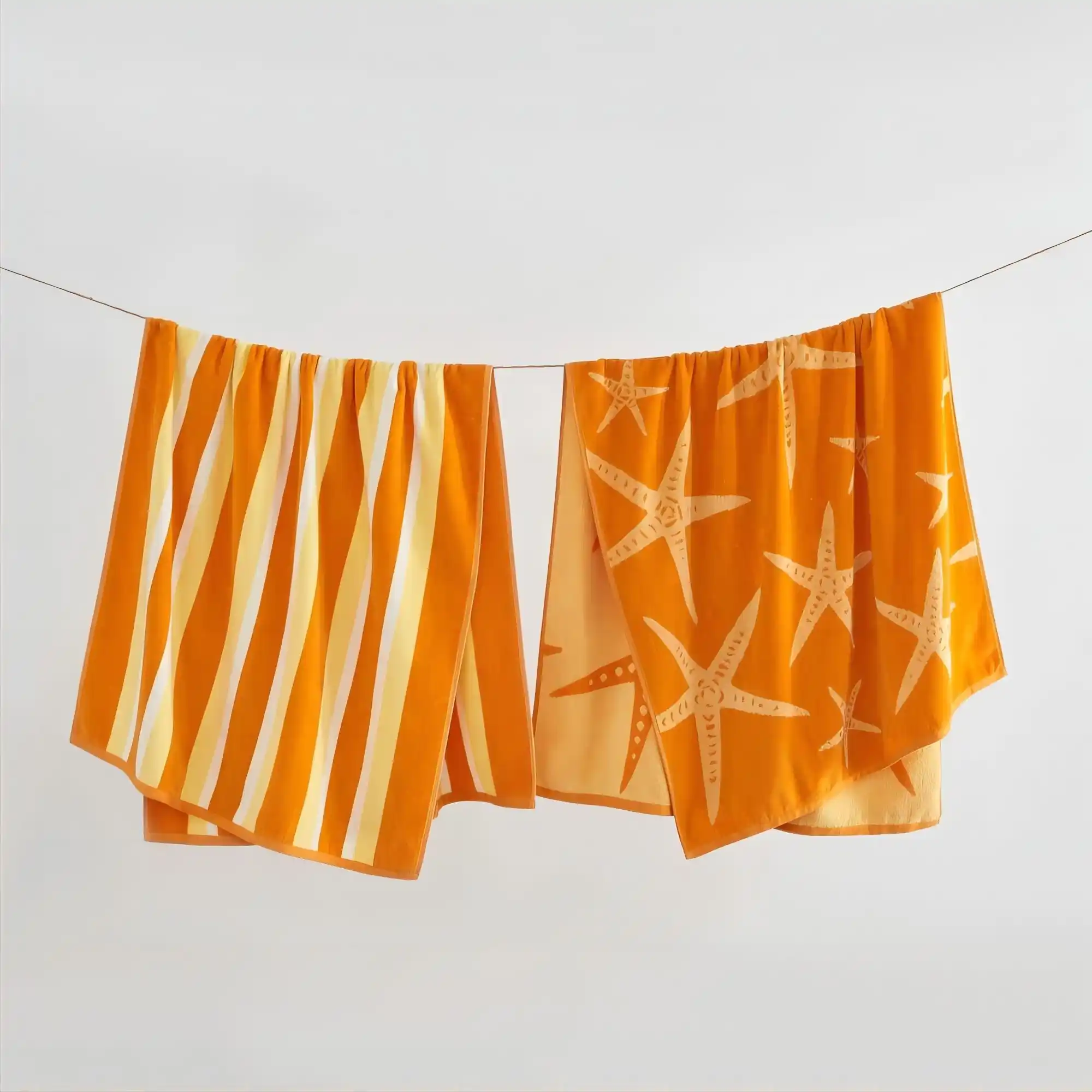
Geometric beach towel designs that behave like optical illusions—stripes, checker distortions, topographic lines, warped grids.
Engineered placement (a border that frames the towel, a centered crest, a corner monogram zone) because it looks custom even when it’s mass-produced.
Micro-patterns that hide wear: tiny repeats disguise abrasion and minor print cracking better than big flat fields.
And here’s the dirty secret: motif choice is often a workaround for production limits. Highly detailed gradients and photo realism are easiest when you choose the right process (hello, sublimation on synthetics; reactive on cotton), but buyers still want predictable color consistency. That’s why motifs are becoming more graphic again—less “photo,” more “vector.”
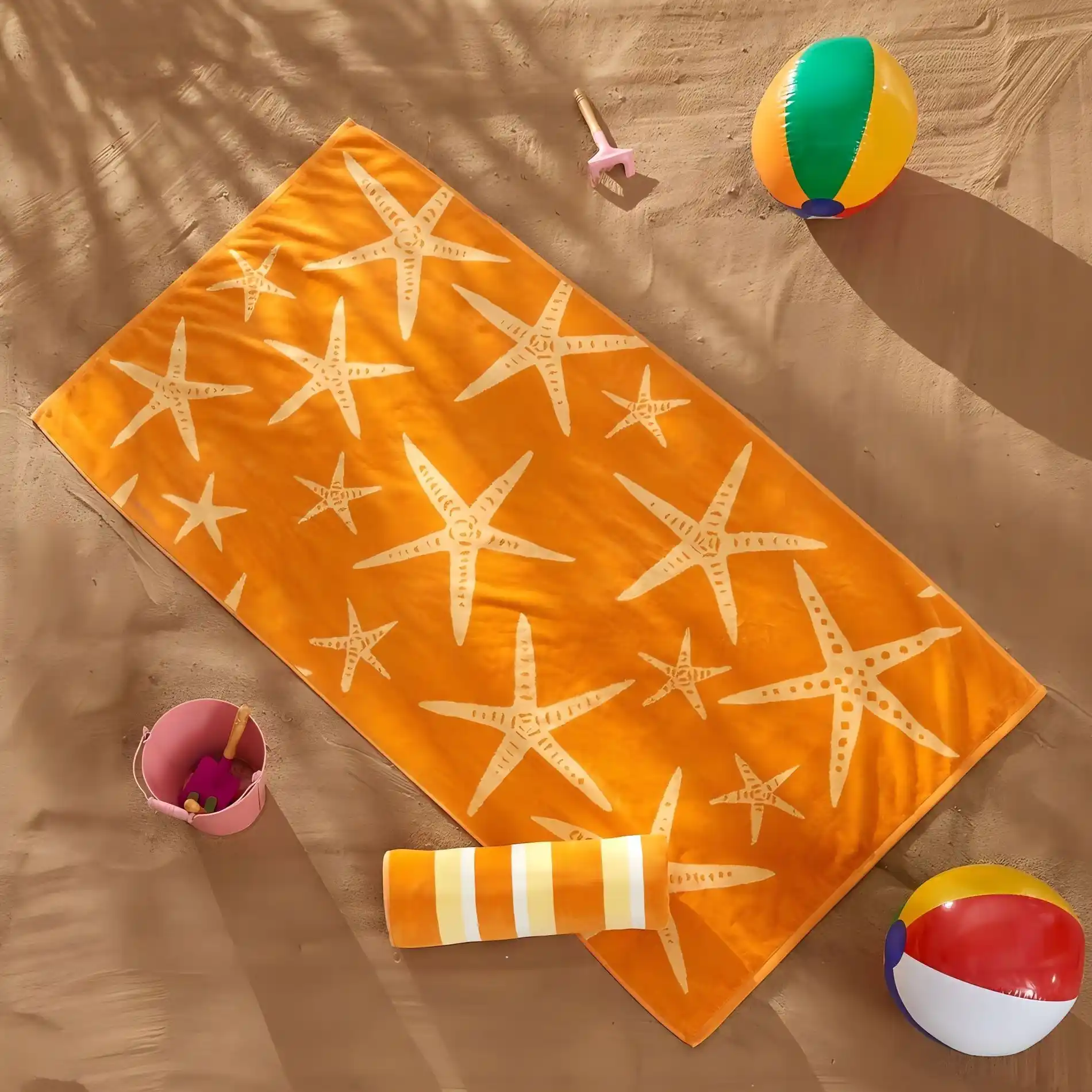
If you’re building a motif-heavy assortment, you’ll want a texture that doesn’t fight the art. That’s why “print + velour face” keeps showing up.
Texture preferences: customers can feel value faster than they can explain it
Texture signals value. In 2026, the towel that wins isn’t always thicker—it’s the one that feels intentionally built, with a face that supports the artwork and a back that performs like a towel, not a decorative blanket. How many returns happen because a “luxury” towel doesn’t actually absorb?
Jacquard is quietly eating the premium tier
A jacquard beach towel is the anti-trend trend: it doesn’t rely on ink at all. The motif is woven into the structure, so it reads as “premium” and tends to hold up visually over time. If you want the “resort lobby” look, jacquard is the safest bet, and you can see the positioning on jacquard beach towel options.
Velour vs terry: this debate is really “art vs performance”
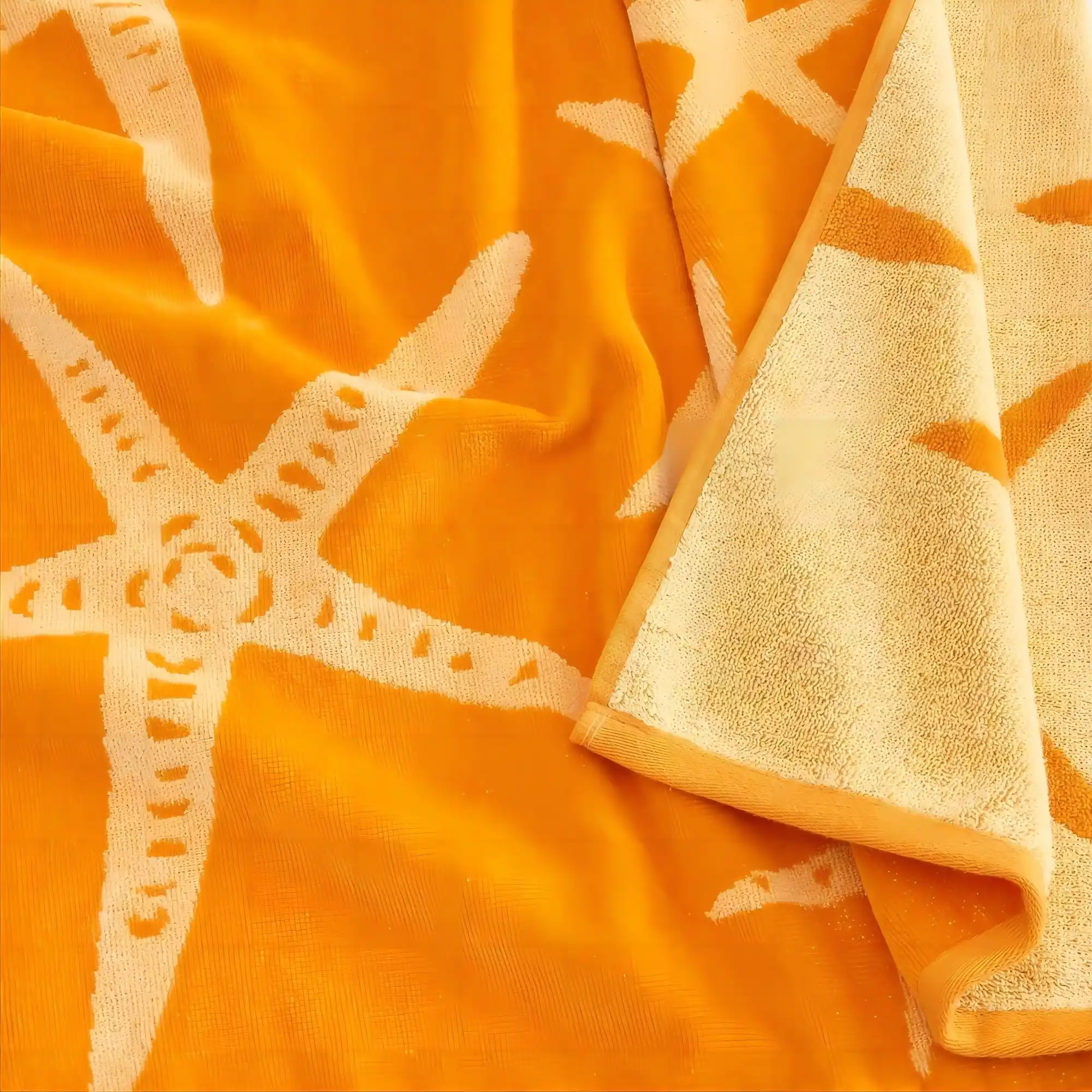
Velour (sheared) gives you a smooth face for crisp graphics and a soft handfeel.
Terry gives you loops that actually drink water and grip sand better.
Most serious programs don’t pick one—they do velour front / terry back. That hybrid shows up everywhere because it solves the customer complaint cycle: “pretty, but useless” versus “useful, but ugly.” For examples of that positioning, browse velour / sheared beach towel constructions.
Microfiber: the performance king with a PR problem
Microfiber beach towels are fast-dry, lightweight, and print like a dream. But they’re also implicated in the microfibers conversation, and that conversation is getting sharper, not quieter.
The U.S. National Park Service puts it plainly: laundering synthetic fabrics is a substantial source of microfibers, and fibers can pass through water treatment and end up in waterways; they even discuss retrofit filters as a mitigation idea: NPS on reducing laundry microfibers. A university-backed 2023 research note out of Keele cites 6,500 to 87,000 tonnes of microfibres shed annually during domestic laundering in the UK, and argues design/manufacturing changes matter: Keele University on microfibre pollution (Oct 27, 2023).
So the 2026 “trend” is not “microfiber is dead.” It’s microfiber needs a defensible story: tighter constructions, anti-shed guidance, and better care instructions. If you want to see the typical product framing, check microfiber beach towel styles.
The sleeper factor: regulation is shaping “design,” whether designers like it or not
Two things are squeezing the category:
PFAS scrutiny: Maine explicitly names textile articles in its 2026 prohibition timeline, and EPA’s PFAS reporting regime under TSCA expands the expectation that companies can explain what chemicals were used and where. Start here: EPA on TSCA Section 8(a)(7) PFAS reporting.
Microplastics policy momentum: the European Commission sets a 30% reduction target by 2030 for microplastics released and highlights restrictions on intentionally added microplastics plus attention to unintentional releases. That’s broad, but it’s directionally important for synthetic textiles: European Commission microplastics policy overview.
If you’re a brand, this changes what you can safely claim. If you’re a manufacturer, it changes what you must document. Either way, it changes the design brief: fewer chemical “enhancers,” more choices baked into fiber + weave + finish.
2026 design + build cheat sheet (what to pick, and why)
Trend choice (2026)
Best for
Why buyers like it
Typical downside
My take
High-contrast brights (teal/coral, citrus/navy)
DTC + social-first brands
Reads instantly on camera
Can look loud in-store if overused
Use as hero SKU, not full wall
Sun-faded neutrals (sand/stone/clay)
Resort + premium retail
Looks “calm” and hides minor wear
Exposes cheap texture fast
Only do this with strong GSM/handfeel
Tropical prints (refined, single-motif)
Mass retail + souvenirs
Familiar demand, easy merchandising
Easy to look generic
Make it engineered placement, not all-over clutter
Geometric/optical patterns
Lifestyle brands
Feels modern, unisex, repeatable
Can moiré or feel cold
Pair with warmer palette to avoid “sterile”
Jacquard woven motifs
Premium tier
Pattern won’t “wash off”
Higher cost, longer dev
Worth it for signature programs
Velour front / terry back
Art-heavy towels
Crisp artwork + real absorption
Slightly more complex QC
Best all-around compromise
Microfiber (travel/quick-dry)
Active + travel
Fast dry, lightweight
Microfiber narrative risk
Add care guidance + tighter construction story
FAQs
What are the best beach towel designs for 2026? A 2026 “best” beach towel design is the one that hits three things at once: a color palette that reads instantly on camera, a motif that survives trend fatigue, and a surface texture (jacquard, velour, or high-loop terry) that signals quality the moment someone grabs it. After that, it’s channel math: DTC wants contrast; resorts want quiet luxury; promo wants logo legibility.
What beach towel colors are trending in 2026? 2026 beach towel color trends skew toward high-contrast coastal brights paired with sun-faded neutrals—teal+coral, citrus yellow+ink navy, and sand/stone bases—because brands are optimizing for phone photography and retail shelf pop without abandoning palettes that still look premium when slightly worn. If you can’t decide, build two capsules: “loud” and “calm.”
Jacquard vs printed: which lasts longer? A printed beach towel carries its design in ink sitting on or inside the fibers, while a jacquard beach towel carries its design as woven structure in the fabric, which typically means better long-term visual clarity after repeated washing, but also higher yarn use and higher unit cost. If you’re selling premium, jacquard is your insurance policy.
Velour vs terry: what’s the difference in towel texture? Velour is a sheared-pile surface where the loops are cut to create a smooth, plush face (great for sharp artwork), while terry is a looped-pile construction built for absorption and grip; in beach towels, many factories blend them as “velour front, terry back” to get both. If art is the product, velour matters. If function is the product, terry wins.
Are microfiber beach towels bad for the environment? Microfiber beach towels are usually polyester (PET, (C10H8O4)n) or polyamide blends that dry fast and print sharply, but they can shed microfibers during laundering, which is why regulators and large buyers increasingly ask for tighter yarn constructions, anti-shed finishing, or a switch back to cotton. If you sell microfiber, you need a mitigation story—not vibes.
How do PFAS rules affect beach towel materials in 2026? PFAS rules affect towel programs by limiting or banning fluorinated stain/water-repellent finishes and even certain fluorinated packaging, so 2026 towel specs increasingly call for “PFAS not intentionally added,” alternative finishes, and documentation that can survive retailer audits and state-specific restrictions. Translation: if your supplier can’t explain the finish, don’t ship it.