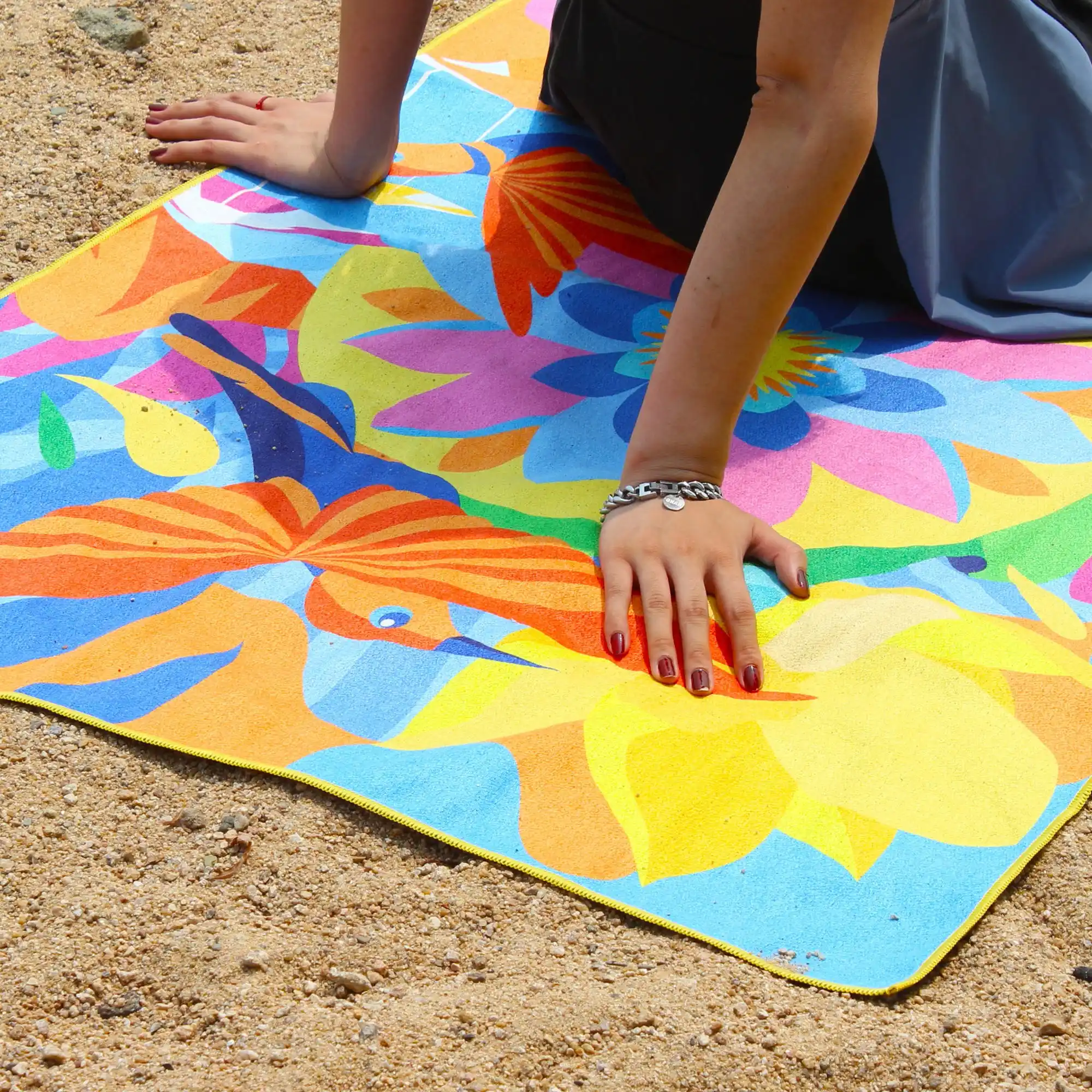
Private Label Beach Towels: OEM/ODM Sourcing Guide (MOQ, Lead Time, QC & Packaging)
This is how private label beach towels actually get made—and how sourcing teams get burned. We’ll pin down MOQ, lead time, QC, and packaging with the ugly details factories avoid.
They don’t always lie with words; they lie with calendars, with “standard” quotes that quietly exclude dye-house queue time, with sample approvals that reset lead time to zero, and with QC language that sounds professional until you try to reject a run and the tolerance suddenly changes. So here’s the hard question: are you buying a towel, or are you buying a system that can repeat the towel 12 months from now without drama?
I’m going to write this like a sourcing manager reads it: suspicious, time-starved, allergic to fluff.
Table of Contents
Start with the risk you can’t see: fiber origin and brand liability
Private label means your logo, your barcode, your problem.
If you’re sourcing cotton terry, you’re stepping into a compliance zone that’s gotten sharper since 2023. Reuters reported that researchers tested 822 products (collected Feb 2023–Mar 2024) and found 19% had traces of Xinjiang cotton; even worse, 57% of positives carried labels claiming U.S.-only origin. That’s not “edge case” territory—that’s systemic slippage in traceability. Reuters report on Xinjiang cotton traces
And enforcement isn’t theoretical either. In May 2024, Reuters covered the U.S. blocking imports tied to 26 Chinese cotton traders/warehouse facilities added to the UFLPA Entity List—explicitly aimed at goods linked to forced labor risk. Reuters on U.S. import blocks and UFLPA Entity List additions
So when a factory shrugs and says “cotton is cotton,” that’s not ignorance. It’s them trying to keep your RFQ simple so you stop asking questions.
If you’re building a repeatable program, skim the site taxonomy first: the supplier positioning here splits products by material, craft, application, and packaging, which is exactly how your cost drivers behave in the real world. Start with the operating model on the OEM/ODM beach towel factory services page and then decide whether your hero SKU is a printed beach towel or a jacquard beach towel—because MOQ, lead time, and defect patterns differ.
OEM vs ODM is not semantics. It’s who owns the mistakes.
Most buyers say “OEM/ODM” like it’s one thing. It isn’t.
OEM (for private label beach towels) usually means you specify: size (70×140 cm vs 76×152 cm), GSM (say 400–550), yarn type, dye method, artwork files, label placements, packaging, carton marks. The factory executes.
ODM means you’re picking from an existing construction or pattern library and customizing enough to call it yours. Faster. Often cheaper. Also easier for the factory to swap materials without you noticing—unless you lock a spec sheet like a lawyer.
If you want a private label program that survives staff turnover on both sides, demand a spec pack that includes:
Bill of materials down to label substrate (polyester satin vs cotton), and packaging film (PE) thickness in microns
Test methods: GSM via ASTM D3776, colorfastness (ISO 105-C06 wash; ISO 105-X12 rub), shrinkage %, skew/spirality, absorbency time
AQL level for final inspection (common: AQL 2.5 major / 4.0 minor—don’t accept “random check” as a plan)
Yes, it’s tedious. That’s the point.
MOQ: the number you’re quoted vs the number that’s real
MOQ fights aren’t about greed. They’re about setup.
A “beach towel MOQ” changes when any of these change:
Dye lot (reactive dyeing in cotton has batch economics)
Weave/loom allocation (jacquard needs loom time; patterns can limit efficiency)
Print method (sublimation on microfiber is a different workflow than pigment/reactive on cotton)
Packaging complexity (retail-ready packing consumes line time and introduces error)
Here’s the truth I wish more brands accepted: if you’re doing custom beach towels wholesale with multiple SKUs, the MOQ isn’t per PO—it’s per production logic. Factories will “agree” to a low MOQ and quietly compensate with higher unit cost, slower lead time, or weaker QC attention. Pick your poison.
If you’re building for retail, you should also look at retail & private label towel programs because application matters: resorts tolerate different defect profiles than a big-box shelf does.
Lead time: why the “30 days” promise keeps dying
Three words: queue eats you.
The best factories don’t run slow; they run scheduled. Your “beach towel production lead time” is basically a collision between your spec complexity and the factory’s capacity plan.
And external conditions still whiplash “predictable” timelines. Reuters reported the New York Fed’s Global Supply Chain Pressures Index ticked up to 0.1 in Feb 2024 (from -0.23 in Jan), the first positive reading since Jan 2023—near normal, but a reminder that shipping and logistics can re-tighten quickly. Reuters on NY Fed supply chain pressure uptick (Mar 6, 2024)
My unpopular take: most late shipments are buyer-caused. Not because you’re incompetent—because internal approvals (artwork, labels, barcodes, carton marks) get treated like “finishing touches.” In manufacturing, those are gating items.
If packaging is in scope, stop treating it like decoration. Use the supplier’s custom beach towel packaging options as a checklist: polybag + insert card + barcode label + carton mark file = the difference between a smooth receiving day and a warehouse chargeback email.
QC: if you don’t define defects, the factory will
QC isn’t a clipboard. It’s leverage.
You need a “beach towel QC checklist” that covers:
Measurement tolerance: length/width (±1–2 cm, defined), squareness, skew/spirality
GSM tolerance: defined range, not “approx.”
Color control: lab dip approval (cotton dyeing), Pantone references where applicable, and what constitutes a fail
Functional tests: absorbency, wash shrinkage, crocking/rub transfer
And don’t ignore category-specific safety. For hooded towel / robe-adjacent items (kids poncho towels, hooded wraps), regulators do act. The U.S. CPSC recall expansion in May 2024 for SIORO children’s robes cited violations of federal flammability standards and burn risk; units were sold around $20–$27 and labeled “Made in China.” That’s not your exact SKU, but it’s your warning flare: textiles + kids + sleepwear-adjacent design = scrutiny. CPSC recall notice (May 9, 2024)
So when a factory says “we can do kids hooded towels easy,” ask what standards they test against and what labs they use. Watch how fast the confidence level drops.
If sustainability claims matter for your channel, don’t accept vibes—accept documents. The supplier’s sustainability and certification page is where you should anchor expectations (OEKO-TEX®, GOTS, GRS), then verify certificate validity and scope before you print hangtags.
The sourcing decision table buyers actually need
Below is a blunt comparison. Treat these as typical ranges, not gospel—your spec, seasonality, and capacity booking decide the final numbers.
Towel Type / Craft
Best Use Case
Typical MOQ Pressure
Typical Production Lead Time Pressure
QC Failure Hotspots
Packaging Fit
Cotton terry + reactive print (all-over)
Retail hero SKU, brand art
Medium (setups + color control)
Medium (dye/print queue)
color shift, misalignment, bleeding, shrinkage
polybag + insert + barcode; gift box for premium
Microfiber (polyester) + sublimation
Vivid graphics, fast-dry, travel
Lower–Medium (print runs scale well)
Lower–Medium (print capacity dependent)
ghosting, banding, edge curling
tight fold + belly band; sand-free claims need clarity
premium belly band; hangtag; often no polybag for “handfeel” (risky in transit)
Embroidered logo on terry
Resorts, corporate gifts
Medium
Medium
puckering, thread breaks, placement drift
hangtag + barcode; polybag if humid shipping route
Recycled rPET microfiber
Eco-positioned quick-dry
Medium (material sourcing)
Medium (material lead)
yarn consistency, pilling, print adhesion
kraft wrap + certification doc insert
FAQs
What does OEM/ODM mean for private label beach towels?
OEM in private label beach towels means you bring the finished spec—size, GSM, yarn, color, artwork, labels, and packaging—and the factory manufactures exactly to that blueprint, while ODM means the factory supplies a ready pattern or structure you tweak, then you brand it as your own SKU. If you’re launching fast, ODM can speed sampling. If you’re scaling across seasons, OEM discipline (spec packs, tolerances, test methods) prevents “silent substitutions.”
What is a realistic beach towel MOQ, and why do factories enforce it?
MOQ for private label beach towels is the minimum unit count a manufacturer will accept for a specific construction and packaging bundle because yarn and dye lots, loom or printing setup, sampling, and QC labor have fixed costs that only make sense when spread across enough pieces to keep unit cost stable. If you want low MOQ, simplify: fewer colors, fewer SKUs, standard packaging, and avoid custom woven labels on day one.
What is the typical beach towel production lead time from approval to shipment?
Beach towel production lead time is the total calendar window from approved pre-production sample to ex-factory shipment, and it is driven by material procurement, loom or print capacity, dyeing and finishing queues, inspection rework, and packing throughput—so it moves fast only when your spec is locked early. The fastest “wins” usually come from boring decisions: finalizing barcodes, carton marks, and packaging dielines before you approve PPS.
What should be included in a beach towel QC checklist?
A beach towel QC checklist is a written inspection standard that turns your spec into measurable pass/fail points—dimensions and GSM tolerances, colorfastness, shrinkage, stitch density, edge straightness, print alignment, labeling accuracy, and packaging count—so the factory can’t redefine “good enough” after production starts. Add AQL targets, defect photo examples, and a rule for rework vs remake. If you can’t describe the defect, you can’t enforce the fix.
What are the best custom beach towel packaging options for retail?
Custom beach towel packaging options are the set of materials and pack-out rules—polybag gauge, belly band, hangtag, insert card, barcode labels, carton marks, and master carton strength—that make a towel warehouse-scannable and shelf-presentable while preventing damage, mildew, and mis-sorting during transit. Retail hates ambiguity: every SKU needs scannable barcodes, consistent folding, and carton labeling that matches ASN/PO logic. Start with custom packaging options for beach towels and insist on a packing SOP.
How do I reduce forced-labor and compliance risk when sourcing cotton towels?
Forced-labor and compliance risk in cotton towels is the legal and reputational exposure that comes from opaque fiber origin, banned inputs, or unsafe product attributes, and it is controlled through documented traceability (farm to yarn), restricted substance testing, and import-ready files that match what’s actually inside the carton. Treat traceability like QC: require fiber origin documentation, keep transaction records, and avoid “origin claims” on packaging unless you can prove them—Reuters’ 2024 testing story shows how often labels and fiber reality diverge. Reuters on cotton trace findings
Conclusion: if you want predictable towels, buy predictability
Want the fast path? Pick one hero construction, one decoration method, and one packaging standard—then scale.
If you’re currently shopping a private label beach towel manufacturer or an OEM/ODM beach towel factory, start by aligning on method and packaging: browse OEM/ODM services, choose between printed beach towels and jacquard beach towels, then lock pack-out using the custom beach towel packaging options. When you’re ready, send one clean RFQ with size, GSM, artwork files, barcode requirements, and your delivery window via the contact page.